“I started with Groundswell in 2015, and I’m a self-taught artist. I came in with just one other young experience, so, fresh in that way, but I had experience as an educator.
I aligned with Groundswell in terms of its credo and mission to serve communities of color - to bring art to students that didn’t have access in their schools, and to use art as a tool for social justice. That’s what I’d been doing in my personal work, so it was an amazing moment for me to discover Groundswell and to come into the community.
The Thompkins project was done during my first summer working with Groundswell in 2016. I worked with Chris Soria. [Every year] Youth from all over the different boroughs sign up to work with the city in some capacity, and we are one of the providers they can elect to work with. So, we get youth from all over and typically there is an effort made to have some of our students be from the community that we will be working in (...) I don’t think we had any youth from Thompkins specifically, but they were from neighboring communities. Some of the issues that might’ve come up in their neighborhoods were similar, so there was still an access point in that sense. Our intention for every project is to take a temperature reading of what’s going on in the world. What would the community like to see? What are our youth responding to in terms of what we’re doing in the classroom from their vantage point, their ideas, the creative formations that are coming about?
Our first week of painting coincided with the unfortunate killings of Philando Castile and Alton Sterling. So, that set a tone. It’s unfortunate that this is something for our youth, and for us all - that this becomes the headline that you see with some frequency. But, I think it was just a lot at once [at that time]. We were charged with figuring out how not to ignore that this is continuing to happen; that this injustice is prevalent, and that we were in a community where people can be profiled - I think this is when Stop and Frisk was still happening. [This was the] mindfulness that we had to bring to the community.
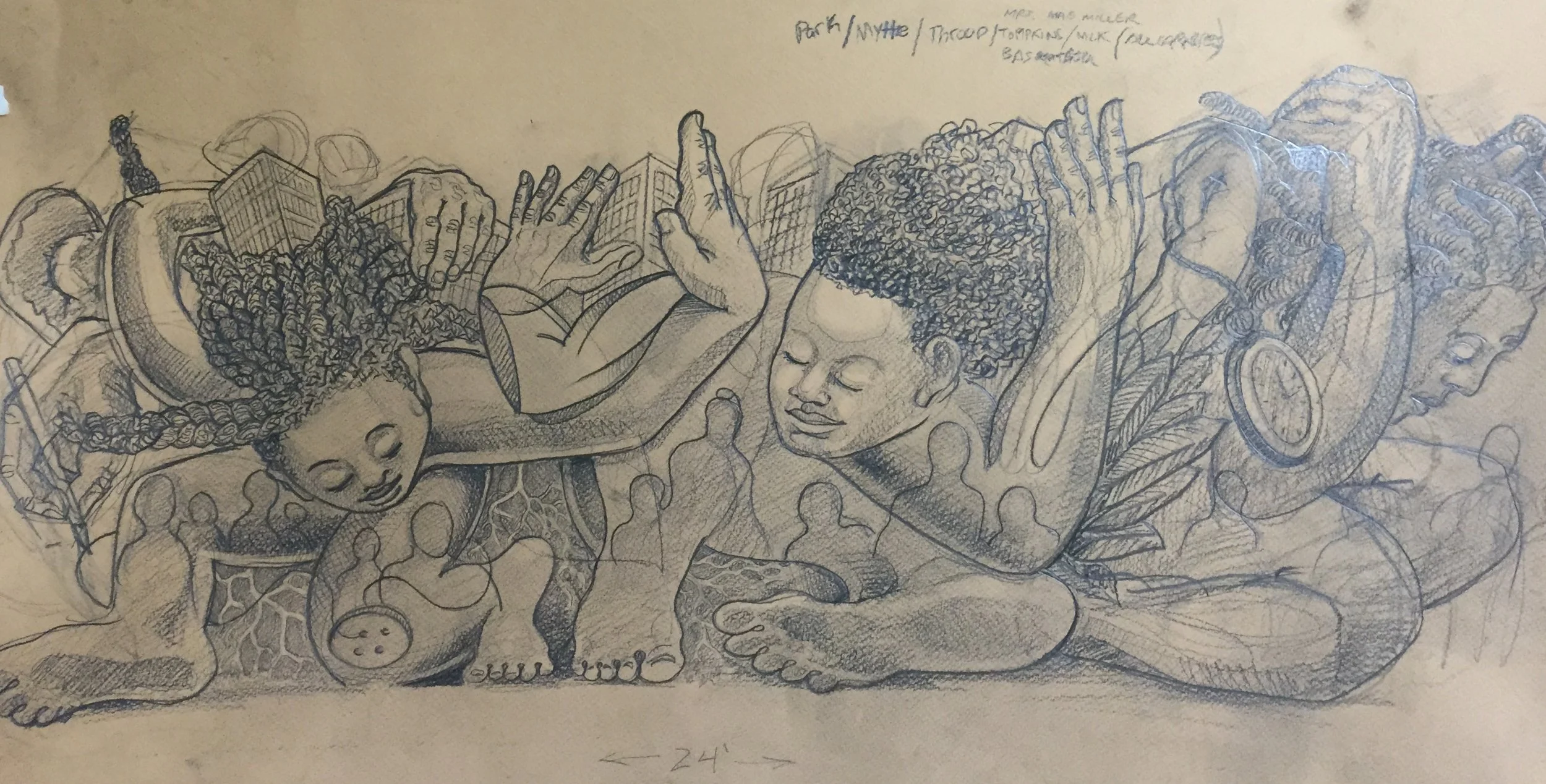
We were painting on a handball court, it was a community space, a space of reimagining, but it was also for kids. So, it was this mixture - how then to make a work that wasn’t going to ignore the harsh realities [of the present moment], but one that would also be in solidarity with Black Lives Matter, holding space for the struggles that were happening but also be uplifting in some way - to be that mixture of feelings. We brought it back to our group, and they very beautifully began... I think it was from a group drawing. Someone did a ship, someone did a boat. And so, [the idea evolved into] being a captain of your own ship - one you can use to navigate yourself through your own path. And that was something that dovetailed into our wider concept. For our kids, this is also their reality. So it was not very far-fetched, they could relate. We ended up making the piece about that - about how to steer your ship; how to be the commander of your journey while also navigating these storms, while also being in community; being a young person trying to imagine your future in a bright way. On one side of the wall are two young people, and they are holding a portal together that’s a kind of swirl - a portal to the future that they’re trying to envision, to aspire to.
[On] the other side of the piece, the same two youth are holding each other through a storm. There’s a ship, and there’s a community again holding each other through. In the end we titled the whole piece Compass of Dreams. We wanted it to be something that gives the young people, gives everyone in the community, a breath of fresh air and is still a meditative piece to look at. [One that] also honors the fact that there are daily struggles and does not ignore that - To show the perseverance of a community. In the end we did find a decent balance of all the things that we were trying to encompass. We actually ended up painting the court itself, so if you took an aerial view it could literally be like a compass and a dial because there is a whole circle surrounding the wall. The whole sphere of the court itself and the wall that stands as the dial.”